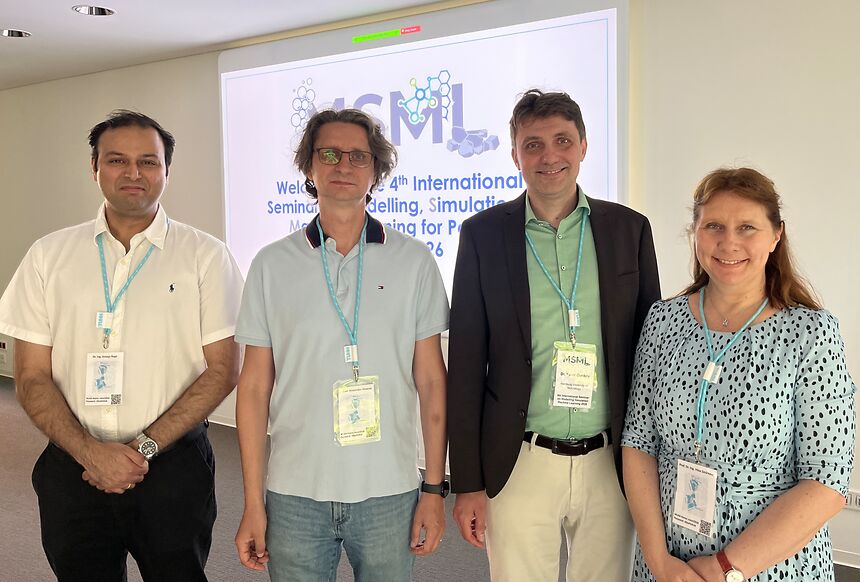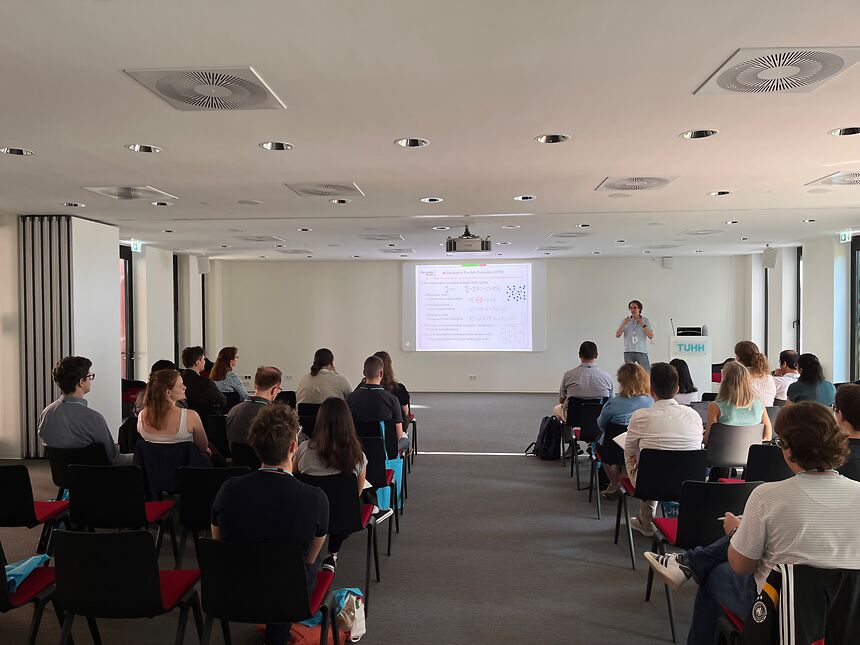
Porous materials play a central in materials research: as solids featuring numerous tiny cavities, they enable a wide range of applications from energy generation and storage to sustainable pollutant separation. These porous materials were the focal point of the "International Seminar on Modelling, Simulation and Machine Learning for Porous Materials Across Scales" (MSML). From June 22 to 24, the conference convened for the fourth time – this time at the Hamburg University of Technology (TUHH). The three-day conference focused on the modeling and simulation of porous materials using machine learning.
To this end, the conference brought together a total of 46 participants from industry and academia, including international researchers from process engineering, materials science, mathematics, chemistry, and computer science. A particular thematic focus of this year’s meeting was on data-driven simulations, research data management, bio-based raw materials, and sustainable porous materials.
New Simulation Models Aid Cancer Diagnosis
The event was hosted by Prof. Dr. Pavel Gurikov, Scientific Coordinator for “Nanoporous Materials” at the Institute of Thermal Separation Processes at TU Hamburg, as well as institute director and TUHH Vice President for Research Prof. Dr. Irina Smirnova. In her welcoming address, she outlined TUHH’s research infrastructure and highlighted in particular the Cluster of Excellence BlueMat, funded with over 70 million euros. This cluster conducts intensive research on porous materials that develop new, extraordinary properties through their interaction with water. These properties can be exploited, for example, to selectively remove pollutants such as chemicals from drinking water or to store energy.
A first highlight was the keynote lecture by Prof. Dr. Alexander Alexeev from the Georgia Institute of Technology. Prof. Alexeev is internationally recognized for his work at the interface of soft matter physics, computational modeling, and biomaterials. Among other projects, he develops computational models to predict the movement behavior of polymers in liquids such as human blood flow. Applications of such models include the development of intelligent biomaterials as well as advanced cancer diagnostics. They can also contribute to a better understanding of blood coagulation processes.
Other leading international researchers from renowned institutions such as the University of Alberta (Canada), the University of Twente (Netherlands), Keele University (England), and the Spanish Foundation for Research and Development in Transport and Energy (Cidaut) also presented their work. A home advantage was enjoyed by Joana Gil Chavez, CEO and founder of the Hamburg scale-up and TUHH spin-off Lignopure. She provided insights into the upcycling of the porous biopolymer lignin using a patented particle technology.
FAIR Data, Professional and Personal Networking
Another highlight was a cross-disciplinary lecture by the Hamburg University of Technology Library (TUB) on research data management and Open Science. The subsequent discussion highlighted the ongoing structural transformation of scientific libraries: shifting away from classical literature management toward becoming active partners in research data, digital science, and FAIR data. The latter describes a data principle whereby scientific knowledge is made freely accessible and machine-readable worldwide.
Beyond academic discussions, the supporting program offered numerous opportunities for personal exchange and networking. On Monday evening, participants attended the TUHH Big Band SwingING’s summer concert. For Tuesday noon, the organizers arranged a trip to the Kiekeberg Museum in the Harburg Hills, followed by a tour of the CampusLabs on the TUHH grounds on Wednesday.